em-smart Dual SE adopts a dual-laser system architecture that combines a fiber laser and a blue semiconductor laser. By integrating two laser sources with different physical mechanisms and wavelength characteristics, the system achieves stable processing of both metal and non-metal materials. This design balances material adaptability, precision control, and system stability within a single machine, forming the core working principle of Dual SE.
¶ Fiber Laser (1064 nm)
A fiber laser is a laser system that uses doped optical fiber as the gain medium, with the resonant cavity primarily formed by optical fibers. The fiber laser used in em-smart Dual SE operates at a wavelength of 1064 nm, which belongs to the near-infrared spectrum and is invisible to the human eye.
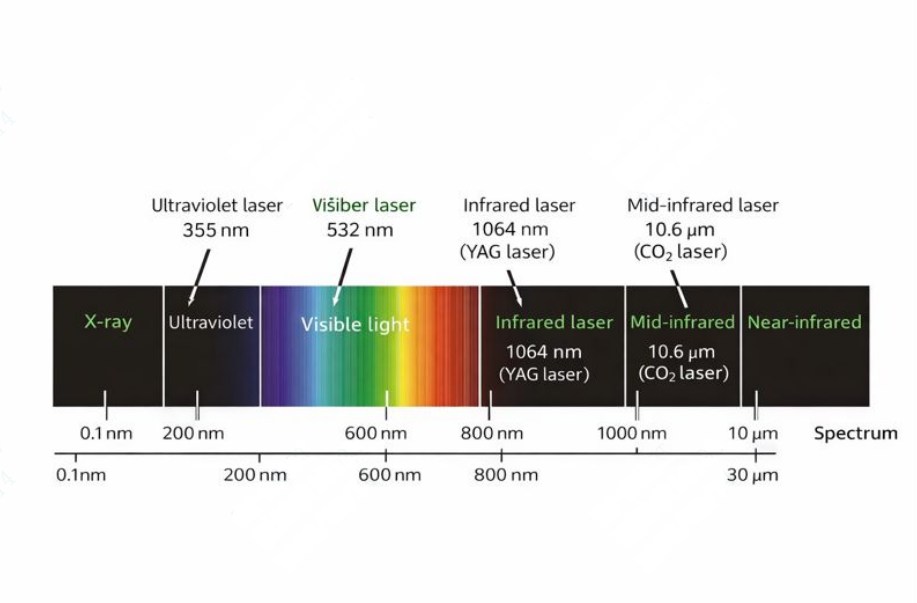
This type of laser typically uses rare-earth-ion-doped fibers as the gain medium, most commonly ytterbium ions (Yb³⁺), and may also include Nd³⁺ or Er:Yb co-doped systems. Under pump wavelengths of 915 nm or 975 nm, Yb³⁺ exhibits a broad emission cross-section in the range of 1010–1090 nm, with 1064 nm located in a high-gain region.
Structurally, fiber lasers employ double-clad fiber technology. The inner cladding is used to transmit the pump light, while the fiber core transmits the signal light, enabling a balance between high-power pumping and single-mode output. By introducing fiber Bragg gratings (FBG) or volume Bragg gratings (VBG) into the resonant cavity for wavelength selection, the output wavelength is stably locked at 1064 nm. Typical linewidths can be controlled within 0.5 nm, while single-frequency systems can even achieve <50 kHz, ensuring output stability and processing consistency.
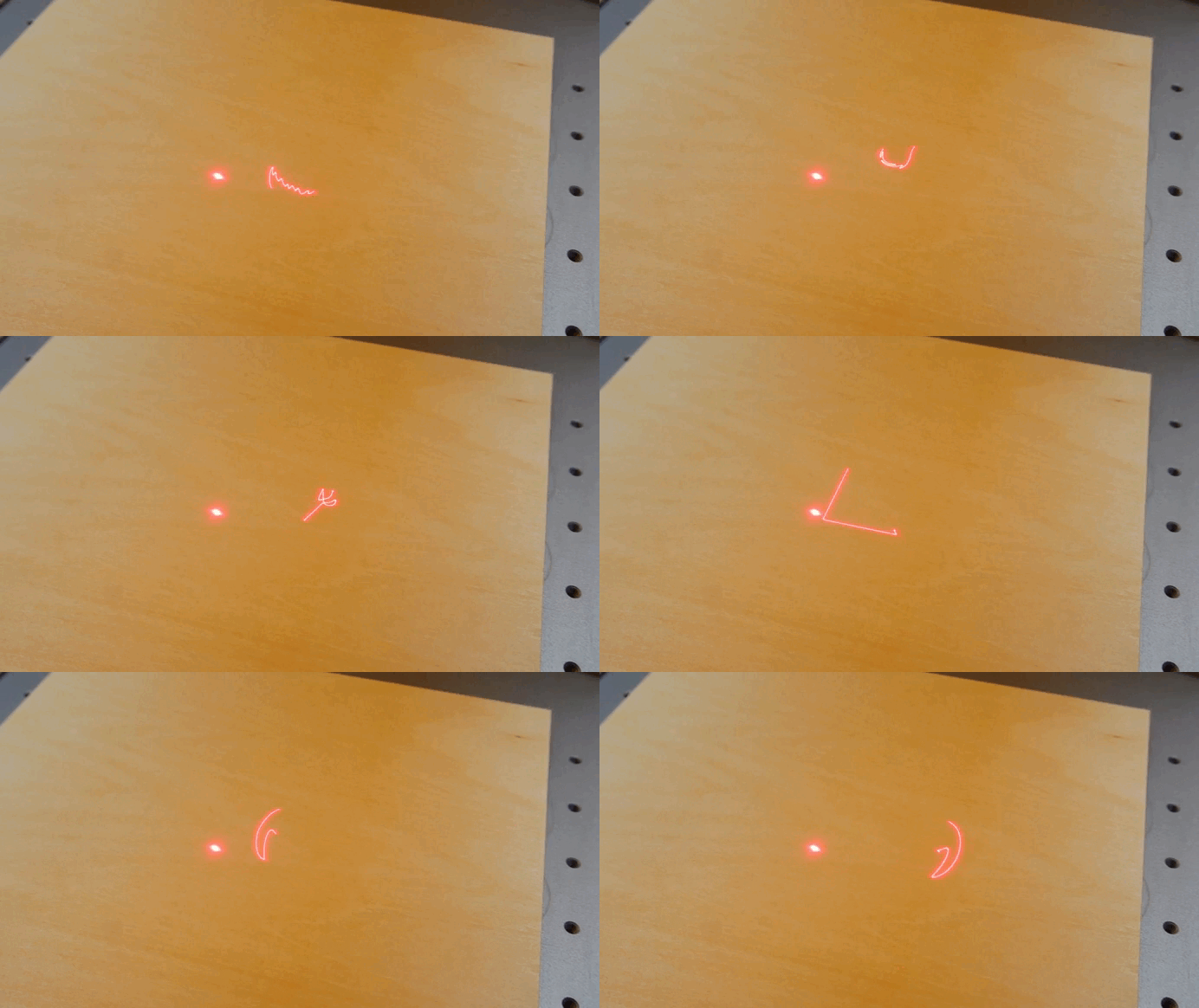
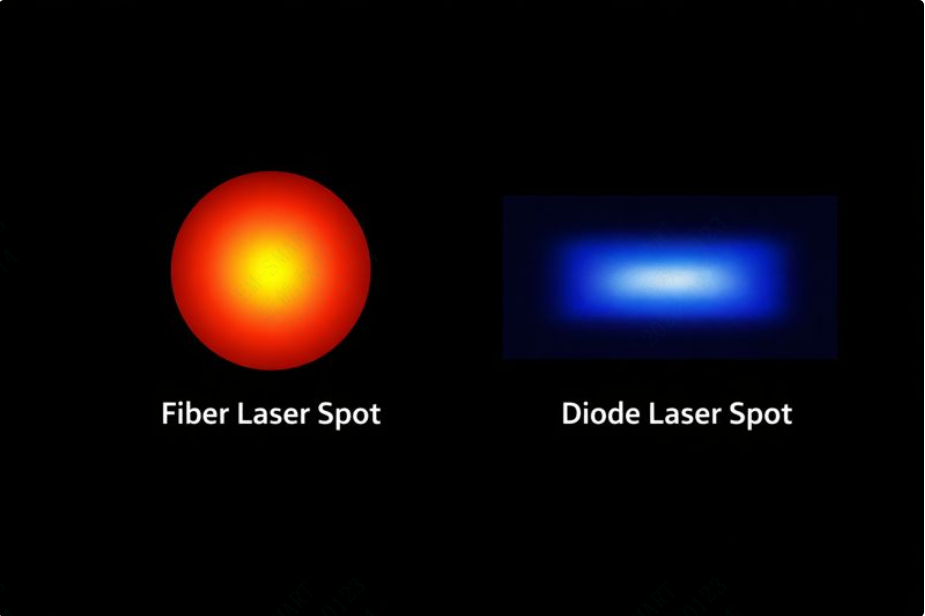
In terms of beam characteristics, fiber lasers generally feature high beam quality, with M² values typically ≤1.6 and an output spot that is close to circular. The 1064 nm wavelength exhibits high absorption efficiency for many metal materials, such as stainless steel, aluminum, and copper, making it suitable for metal marking, fine engraving, and industrial processing applications that require high consistency. Since this wavelength is invisible, infrared detection cards or thermal imaging devices are usually required for observation and adjustment during setup and calibration.
¶ Blue Semiconductor Laser/Diode Laser (455 nm)
Diode lasers operate in the visible blue light spectrum. In em-smart Dual SE, the diode laser has a central wavelength of approximately 455 nm, typically within the range of 445–465 nm. The photon energy at this wavelength is about 2.7 eV, which is approximately 2.3 times higher than that of a 1064 nm infrared laser photon.
In terms of physical principles, diode lasers differ significantly from fiber lasers. Their core generation mechanism is based on semiconductor laser diodes made from gallium nitride materials (GaN / InGaN). Laser emission is achieved through direct current injection, causing electronic energy-level transitions and stimulated emission, without relying on rare-earth ion energy systems. The laser can be output directly, or its power and beam stability can be enhanced through multi-diode beam combining or fiber coupling methods.
Regarding output characteristics, diode lasers typically have beam quality values higher than M² = 1.6, and the output spot is often rectangular in shape. Due to the shorter wavelength and higher photon energy, diode lasers demonstrate good processing adaptability for various non-metal materials and certain organic materials, making them suitable for fine processing applications with strict control over the heat-affected zone.
¶ Dual-Laser Differences and Synergy
From a wavelength perspective, fiber lasers operate at 1064 nm and are invisible, while blue lasers operate at 455 nm and are visible. In terms of output methods and beam characteristics, fiber lasers achieve high-quality single-mode output through double-clad fibers, producing near-circular beam spots, whereas diode lasers primarily rely on direct semiconductor emission and typically produce rectangular beam spots.
From a material adaptability standpoint, fiber lasers are better suited for metal materials, while diode lasers offer clear advantages in non-metal material processing. Dual SE achieves multi-material processing capability within a single machine precisely through this differentiated division of roles.
¶ Core Parameters for em-smart Dual SE
em-smart Dual SE adopts a combined design of fiber laser and blue semiconductor laser, with laser wavelengths of 1064 nm + 455 nm.
- The fiber laser power is 20W, and the diode laser power is 20W.
- The system’s repeat positioning accuracy is ±0.001 mm, based on actual measurement results.
- The standard marking area is 150 mm×150 mm.
¶ Material Compatibility
In terms of material compatibility, the dual-laser source system supports a wide range of metal and non-metal materials. This section is intended only to describe the material adaptability range and does not elaborate on specific application scenarios.
- Metal materials include stainless steel, aluminum, copper, iron, zinc alloy, etc.;
- Non-metal materials include acrylic, rubber sheets, wooden boards, PVC sheets, ABS sheets, PC sheets, cardboard, fabrics, painted wood, slates, and stone slabs.
¶ File and Software
Regarding file compatibility, the Dual SE supports a wide range of common design and processing file formats. The marking results after file import are related to software parsing methods.
- EZCAD supports AI, PLT, DXF, JPC, SVG, NC, BOT, GBR, DST, BMP, JPG, JPEG, GIF, TGA, PNG, TIF, TIFF, and other formats;
- LightBurn supports BMP, JPG, JPEG, PNG, GIF, TIF, TIFF, TGA, WEBP, AI, PDF, SC, DXF, GC, GCODE, NC, HPGL, PLT, RD, SCPRO2, SVG, LBRN, IMAGE, and other formats.
In terms of system support, LightBurn supports Windows and macOS, while EZCAD supports Windows systems. Actual compatibility depends on the officially supported software versions.
¶ Electrical and Physical Parameters
em-smart Dual SE’s power requirement is DC 24 V/7.5 A and includes a standard power adapter. The adapter input range is AC 110–240 V, 50–60 Hz. Power cord specifications (US standard, EU standard, or CN standard) are provided according to the destination region.
In terms of physical dimensions and weight, the machine dimensions are 293 × 399 × 485 mm, with a net weight of approximately 16.4 kg. The packaged dimensions are 370 × 535 × 570 mm, with a shipping weight of approximately 23.65 kg.